
Parents & Online Learning
Online Quran Lessons for Siblings: One Plan or Separate Plans?
Siblings can share a home routine while still needing different teachers, levels or lesson goals because age and family relationship do not…
Practical guides for children, adults and families learning Quran, Arabic and Islamic Studies online.
Siblings can share a home routine while still needing different teachers, levels or lesson goals because age and family relationship do not…

Busy adults usually make better progress with a small routine that survives work and family responsibilities than with an ambitious plan that…

A family can share a Quran routine while giving each child and adult a different goal based on level, available time and…

A second subject should be added when the current routine is stable, the learner has enough weekly capacity and the new subject…

Arabic reading becomes faster when letter shapes and common word patterns are recognised automatically, not when the learner simply tries to move…

Arabic roots are useful as word-family clues, but context still determines what an individual word means in a sentence or Quran verse.
Arabic pronouns are easier to remember when learners meet the highest-frequency forms inside useful sentences before studying the full grammar chart.

Beginners can understand Arabic sentence structure more easily when they first identify whether a sentence is built around a noun-based or verb-based…

High-frequency prepositions become genuinely useful when they are learned inside phrases and connected to attached pronouns and real sentence meaning.
Studying vocabulary inside one Surah gives new Arabic words a memorable context and repeated opportunities to be recognised during Quran reading.

Thirty focused minutes can produce useful progress when review is protected and one main language skill receives most of the session.
Tawheed should give beginners a clear understanding of worshipping Allah alone and learning about Him from reliable revelation rather than becoming only…
Children benefit from learning a smaller number of authentic Names with clear meanings and practical connections to worship rather than racing through…
Beginners should start Fiqh with the worship and practical responsibilities they need now, leaving advanced comparative discussions until the foundations are stable.
Quran learning should develop sincerity, patience, respect and willingness to accept correction alongside recitation and memorization skills.
Jumuah is more than a change to the midday prayer schedule; beginners should understand preparation, the khutbah and the congregational worship of…

Children should experience Ramadan as a month of Quran, worship, dua, generosity and family faith rather than only counting the hours until…

Beginners should understand Zakat as an obligatory act of worship with specific conditions before moving into detailed calculations for personal assets.

Hajj and Umrah share sacred places but remain distinct acts of worship with different timing, obligations and full sequences of rites.

Sincere repentance means returning to Allah with regret, leaving the wrongdoing and making a real effort to change without falling into despair.

Online Islamic content should be evaluated by its evidence, teacher qualifications, context and connection to reliable scholarship rather than popularity alone.

A consistent device, microphone, camera and learning-material setup prevents technical problems from taking time away from the actual lesson.

Resistance does not always mean a child dislikes Quran; the task may be unclear, too long, badly timed or beyond what the…

Healthy motivation grows when children can see progress, connect with the teacher and experience Quran positively at home instead of negotiating for…
Parents should know who is teaching, which communication channels are used, how accounts are managed and how a child can report anything…
The best lesson time is one the learner can actually concentrate in and the family can realistically maintain during ordinary busy weeks.

A useful progress report tells parents the current level, observable improvement, recurring difficulties and the next learning goal rather than simply saying…

Teenagers usually respond better when the teaching respects their age, explains the purpose of practice and gives them increasing ownership over their…

Moving from controlled Qaida exercises into a full Quran page should be gradual so the learner can transfer familiar reading patterns without…
Beginners learn Ghunnah more reliably when they first hear the nasal quality clearly and then practise it only in the Quran situations…

Madd becomes easier when the learner first understands the sound of controlled lengthening and only then adds the detailed Tajweed categories.
Qalqalah should create a controlled release in the correct letters without turning that release into an extra vowel or syllable.

The rule families become easier when the student hears what happens to the Noon sound before memorizing large groups of following letters.
Meem Sakinah is easier to understand when learners combine what they hear with the visible movement of the lips.
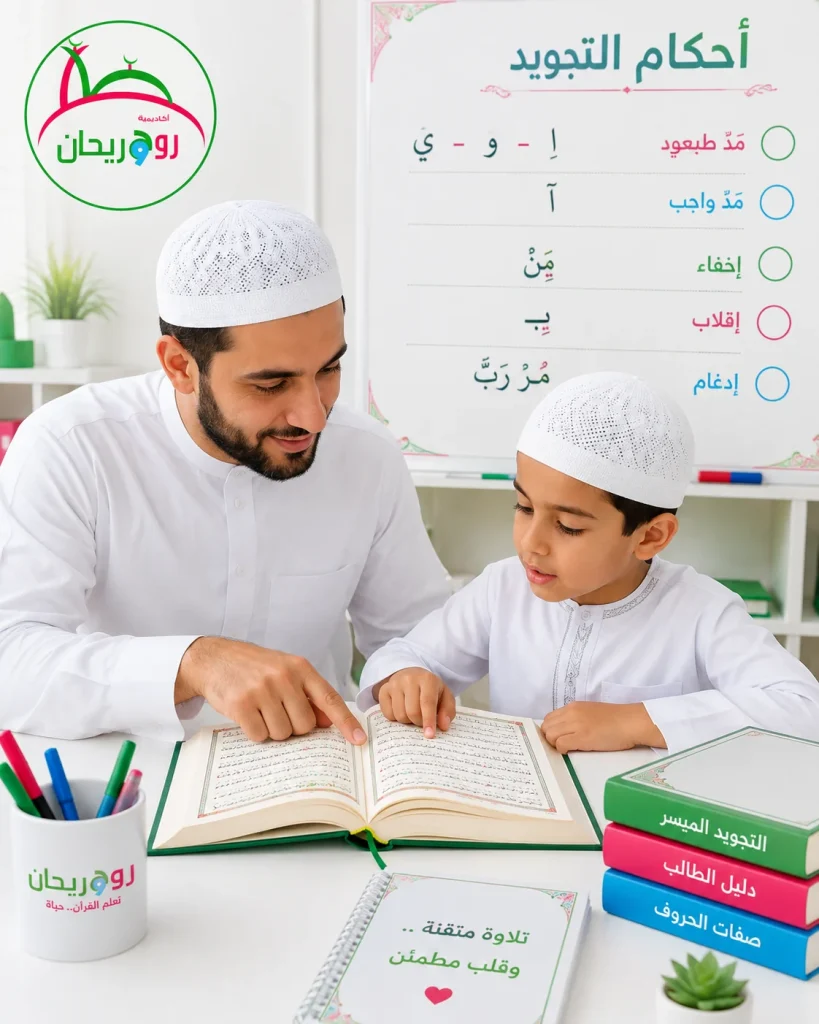
A good Quran reader needs to know not only how words sound, but also how to pause and restart without damaging clarity…

A strong Hifz plan separates new, recent and older memorization so each type receives the revision frequency it actually needs.

Long Surahs require more than learning new verses because earlier sections and transitions must remain stable while the memorized passage continues to…
After completing Juz Amma, the learner should first make the completed Juz reliable and then choose the next memorization stage according to…

Most Hifz problems come from the structure of the routine: too much new material, weak testing, inaccurate repetition or insufficient revision.
Arabic pronunciation improves when the ear learns to hear unfamiliar sound differences and the mouth practises the new movement deliberately.

Listening becomes manageable when beginners use very short material with mostly familiar vocabulary and return to the same audio for different purposes.
Beginners do not need perfect grammar before speaking; they need small predictable conversations that let familiar vocabulary become active.

Fluency should grow from accurate recognition and repeated reading, not from forcing speed.

Correction is most useful when the learner understands the exact error and repeats the corrected version before the old habit returns.

Quran reading and spoken Arabic are related skills, but a learner can begin reading the Quran before becoming conversationally fluent in Arabic.

A returning learner should identify what is still strong and rebuild only the skills that have become weak instead of assuming everything…

A beginner lesson works best when it has one or two clear reading goals, enough student practice and a small home target…

Home practice is most effective when it repeats the exact skill or correction from the lesson rather than becoming random extra reading.
Confidence grows when correction is predictable and the learner receives repeated chances to try again without feeling that every mistake is a…
A useful assessment finds the strongest reliable starting point by checking decoding, pronunciation, fluency and the learner own goals.

US families often need online Quran classes that fit school schedules, different time zones and the needs of children growing up outside…

UK learners can use online Quran classes to find a teacher and schedule that fit the student rather than depending entirely on…
Online learning can help families in France combine Quran reading with Arabic development even when Arabic is not the main home language.

Online Islamic education can give families in Canada and Australia more teacher choice, but time zones and realistic routines need careful planning.

A child can dislike one hard lesson without needing a new teacher, but repeated discomfort deserves careful attention.

Changing teachers is sometimes the practical step that restores communication, confidence or progress without blaming either side.
Parents can make online Quran learning much stronger without correcting every word or sitting through every minute of class.

A good online Quran class is not simply a video call with a Quran teacher; the lesson needs structure, participation and age-appropriate…
The right first program depends on what the learner can already do and what problem the family is actually trying to solve.

A practical explanation of Tajweed for learners who want accurate Quran reading without getting lost in technical terminology.
Makharij become much easier when they are treated as physical pronunciation skills rather than a list of complicated Arabic terms.

A practical method for improving Quran pronunciation one recurring sound or reading habit at a time.
Tajweed does not need to wait until a learner is fluent, but the way it is taught should match the student’s reading…

Hifz becomes more manageable when new memorization stays small enough for old memorization to remain strong.

Children can build strong Quran memorization when progress, revision and emotional comfort are kept in balance.
Revision becomes easier when old Quran is organised into a rotation instead of waiting until forgotten passages suddenly appear.
Juz Amma is a common starting point for Hifz, but the best order depends on the learner’s reading, retention and current Surah…
Tajweed and Hifz are not competing subjects; a good plan uses enough recitation accuracy to protect what the learner memorizes.

Long-term Hifz depends less on one perfect memorization phase and more on the revision system that continues afterward.

Learning Arabic becomes clearer when you decide which Arabic skill you actually need first and build a routine around that goal.
Knowing the alphabet means more than reciting letter names; beginners need to recognise each letter when its shape changes inside words.
Harakat are small marks with a large job: they tell a beginner how the consonant should be voiced inside the word.
Connected Arabic becomes easier when beginners stop treating positional forms as completely new letters.

Quranic Arabic and Modern Standard Arabic share a deep linguistic foundation, but learners use them for different immediate purposes.

Vocabulary becomes useful when a learner can retrieve the word inside a sentence, not only recognise it on a flashcard.
Reading Arabic words aloud and understanding Arabic text are related skills, but they need different kinds of practice.
Arabic grammar becomes far easier when each rule is attached to a sentence the learner already wants to understand.
Parents do not need to speak fluent Arabic for their child to build a real relationship with the language.
Arabic can open important layers of Quran vocabulary and structure, but language study and Tafsir are not the same thing.

Islamic Studies becomes easier when foundational belief and worship are learned in a clear order and connected to daily life.

The Five Pillars provide a simple framework for understanding several central acts of Muslim faith and worship.

A beginner-friendly overview of Wudu that connects the physical sequence of ablution with preparation for prayer.
A beginner-friendly explanation of Salah that separates the physical sequence, recitation and deeper meaning into manageable stages.
Seerah gives students the historical and human setting in which Islamic teachings were lived, taught and demonstrated.
Islamic manners become memorable when children practise them in ordinary family situations rather than only memorising a list.

Daily duas become easier for children when the supplication appears at the moment it belongs instead of only on a memorization sheet.

The six articles of faith provide a simple framework for several core areas of Muslim belief.

Children often learn Islamic values more deeply through repeated family experiences than through long explanations alone.

A family Islamic routine works best when it is small enough to continue during ordinary busy weeks.

A trial lesson gives you information a teacher profile cannot: how the teacher actually listens, corrects and responds to the learner.
A practical starting guide for adults and children who want to learn Quran online from the beginning without rushing the foundations.
What Noorani Qaida teaches, who benefits from it, and how to use it as a practical foundation rather than simply finishing pages.
There is no honest one-size-fits-all deadline for Quran reading. These are the factors that actually influence progress.
What useful Quran learning looks like for children and how parents can support progress without turning every lesson into pressure.
Adults often delay Quran lessons because they feel they should already know how to read. A practical guide to starting from your…
A qualified teacher matters, but so does the way that teacher listens, corrects, explains and responds to the individual learner.
Private and group Quran classes can both work well. The better choice depends on how much correction, flexibility and social learning you…
More classes are not always better. A useful Quran schedule balances teacher contact, short practice and enough time for skills to settle.
Most beginner mistakes are fixable when they are noticed early. These common habits can slow reading even when the learner is practising…
A practical weekly Quran routine that works around school, work and family life without turning every study session into a long class.
Continue through the learning library at your own pace.